
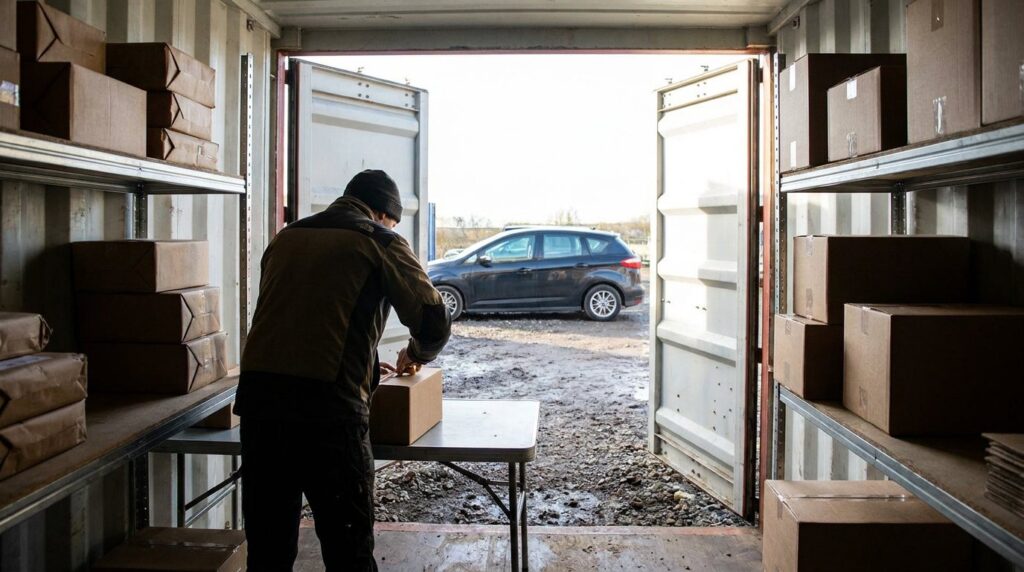
Most online sellers start at the kitchen table. Then the spare bedroom fills with stock, the hallway gets lined with parcels and the garage stops being somewhere to park a car. At some point the business needs a home of its own, and a storage container can be a practical next step before committing to a full commercial lease.
Why a container suits a small e-commerce business
A 20ft container gives a long, regular space with wide doors at one end. That shape lends itself to an orderly layout: shelving along both walls, a clear aisle down the middle and a packing point near the entrance. Because you are not sharing the space, you can arrange it exactly as your products and routines require. It also puts a clear boundary between home life and business life, which many sellers find valuable in itself.
Shelving that makes the most of the space
Free-standing boltless racking is the usual choice, because it needs no fixings into the container walls and can be taken down if you move on. A few points to consider:
- Use deeper shelves low down for heavy or bulky stock and shallower ones higher up for small, light lines.
- Keep the aisle wide enough to turn round with a box in your arms.
- Leave a little space between racking and walls so air can move around your stock.
- Use clear plastic tubs or open-fronted bins for small items so you can see contents at a glance.
- Label every shelf with a simple location code, such as left-side, bay two, shelf three.
Building a picking routine
The difference between a calm dispatch session and a frantic one is usually the picking routine. Print or download the day’s orders, sort them by location code, then walk the aisle once collecting everything in order rather than darting back and forth. Put your fastest-selling products on the shelves nearest the doors so the most frequent trips are the shortest.
Many sellers find it efficient to visit the container at a set time, pick and pack everything, then head straight to the courier drop-off or post office. Batching the work this way keeps the rest of the day free for listing, sourcing and customer messages.
Keeping inventory organised
Stock that cannot be found might as well not exist. Tie your location codes into whatever inventory system you use, even if that is a shared spreadsheet. When new stock arrives, record it as it goes on the shelf, not later. Carry out a quick count of a few lines each visit, rotating through the range so everything gets checked over time. Keep returned items on a dedicated shelf until they have been inspected, so they do not get mixed back in untested.
Security and access for stock you depend on
When your stock is your income, how and when you can reach it matters as much as where it is. Drive-up access saves time on every visit, and round-the-clock access lets you fit dispatch around other commitments. In Bristol, Wilkinsons Self Storage on Trench Lane offers brand-new 20ft steel containers in an outdoor yard where you can park beside your own container and load directly, with access available 24/7. Its Bristol containerised storage is used by online sellers for inventory as well as by householders and businesses.
The yard is securely gated and fully floodlit, with 24/7 monitored CCTV, and a padlock is supplied. New containers avoid the leaks and condensation that can affect older, worn ones, which matters for cardboard packaging, printed goods and textiles. Weekly or monthly contracts mean the arrangement can flex with seasonal peaks rather than locking you into a long agreement.
Planning for growth
A container is a good test of how much space your business genuinely needs. Keep notes on how full the shelves get at your busiest times, how long picking takes and which products tie up the most room. If you outgrow one container, you will have hard information to guide the next decision, whether that is reducing slow-moving lines or looking for larger premises.
Moving stock out of the house can transform an online business. With sensible shelving, a disciplined picking routine and good stock records, a single container can serve as a tidy, efficient base for a growing shop, and give you your home back at the same time.


